AI Engineer — who is that?
Agentic Engineering — what is it?
In 20 years in IT, 15 of them in quality assurance, I have tested a great deal of other people’s code and written no less of my own — but still for testing other people’s. There were also 2 pet projects, with so much time, money and effort poured into them that they simply could not end in anything but burnout. On the web the rule is simple: build a lot, and at least 1 in 10 will take off. The figure is rough, but many well-known examples have confirmed it more than once. But what if you don’t have the money, time and energy for 10 projects? Then try to make it with 2 or 3 and burn out — that is how it was until recently, until the era of AI and of software built entirely by agents.
This very site is a vivid example. Four weeks, a zero budget, the free Cloudflare plan, and every best practice of software development followed. Most of the code was written by AI agents. I set the tasks, often as user stories, and made the decisions — checking every step at first, then testing everything by hand. In other words, I did exactly what a QA Lead does for a whole career, only now my team was made of agents. In the end I built my own feature development pipeline, and the fear that AI might do something wrong went away for good: I came to understand that the only places to go wrong are the prompt and the way a task is set and broken down — and that is the main difference between…
Vibe coding and Agentic Engineering are not the same thing
Vibe coding is «asked, got it, deployed without reading». It works right up to the first bug in production, and then it turns out that nobody — neither the human nor the model — understands how the thing works.
Agentic Engineering is the engineering discipline of working with AI agents. The human is the architect, the product owner and the QA; the agents do the work. An AI agent is like a very fast and very diligent junior: never tired, never argues, reads documentation in seconds — and now and then is wrong with great confidence. Familiar to anyone who has ever been a team lead =)
So the rules are the same as in any good team:
- a task is worded so that it cannot be understood in two ways;
- every decision has a reason, written down in words;
- nothing counts as done until it is checked — by a test, a build, your own eyes;
- only what passed every check goes to production.
Sound familiar? A good QA engineer already has a tear rolling down their cheek — these are the four pillars that hold up the quality of any product. It is what I have been doing for 15 years anyway, but with AI these skills have become critical and decisive, which means QA Driven Development is Agentic Engineering — and it is no longer science fiction.
Senior AI engineer — how to become one?
To answer this, we first need to understand the qualities and habits an AI engineer must have to reach their goals with fewer tokens, that is, as cheaply and as quickly as possible. We have already answered it above: it is the one who best understands the whole flow
Task → Breakdown → Execution control → Result control → Retrospective that turns the summary into useful skills and patterns
and can loop it well. In other words, someone who can do everything, but above all can and wants to answer for the quality of the result — its quality, not just its existence. Many will have guessed by now that, just as with good managers, good AI engineers grow out of the very same QA, because TDD is almost the only pattern for building AI-driven pipelines: even SDD is impossible without TDD. So testers and automation engineers — this is your moment! Everyone else (developers, designers and so on) will have to brush up on testing before moving into AI engineering.
AI Engineering — there can be only one
Writing code is the smaller part of the job. AI product engineering is when an engineer owns the whole product: what to build, for whom and why, what it will look like, whether search engines will find it, what it will cost and what happens if something goes down. Strike out everything about the idea itself, keep only the implementation tasks, and you get the task list of an AI engineer:
- Brand/Style — name, logo, palette, brand book, social media cards.
- Copywriting — my own texts in Russian and translations into English, Ukrainian, Polish, Spanish and German.
- SEO — keyword research, metadata, sitemap, hreflang for six languages.
- Architect — constraints as part of the design.
- QA — the most important part: quality assurance in both the processes and the artifacts.
- Automation — the most advanced (senior) part: making agents learn on their own and giving them the right motivation (automatic triggers), so the work runs in cycles and only the rare key phases need your review — without losing sync or quality, because you are still the chief judge.
Familiar team roles such as «project manager», «product owner» and «scrum master» are already automated inside the SDD framework, so their skills matter less for how fast they move into AI engineering — but they will have to move too, because in the end there will most likely be just 1 technical position left: AI engineer.
What it means for you
AI does not replace engineers, does not abolish testers and does not leave project managers out of work. On the contrary, it finally lets each of them be everything for their project, instead of rallying the unrallyable around a common goal that none of them ever really understood, because each was busy with their own small piece of work — no less important for that. It gives superpowers to those who can set tasks and check the result. Agentic Engineering is a team’s speed with quality control added, not removed or faked. The site you are reading this on is the proof. Built by a non-programmer, in a couple of evenings, with impressive results on the key metrics… using ONLY free tools… sounds like science fiction, but it isn’t.
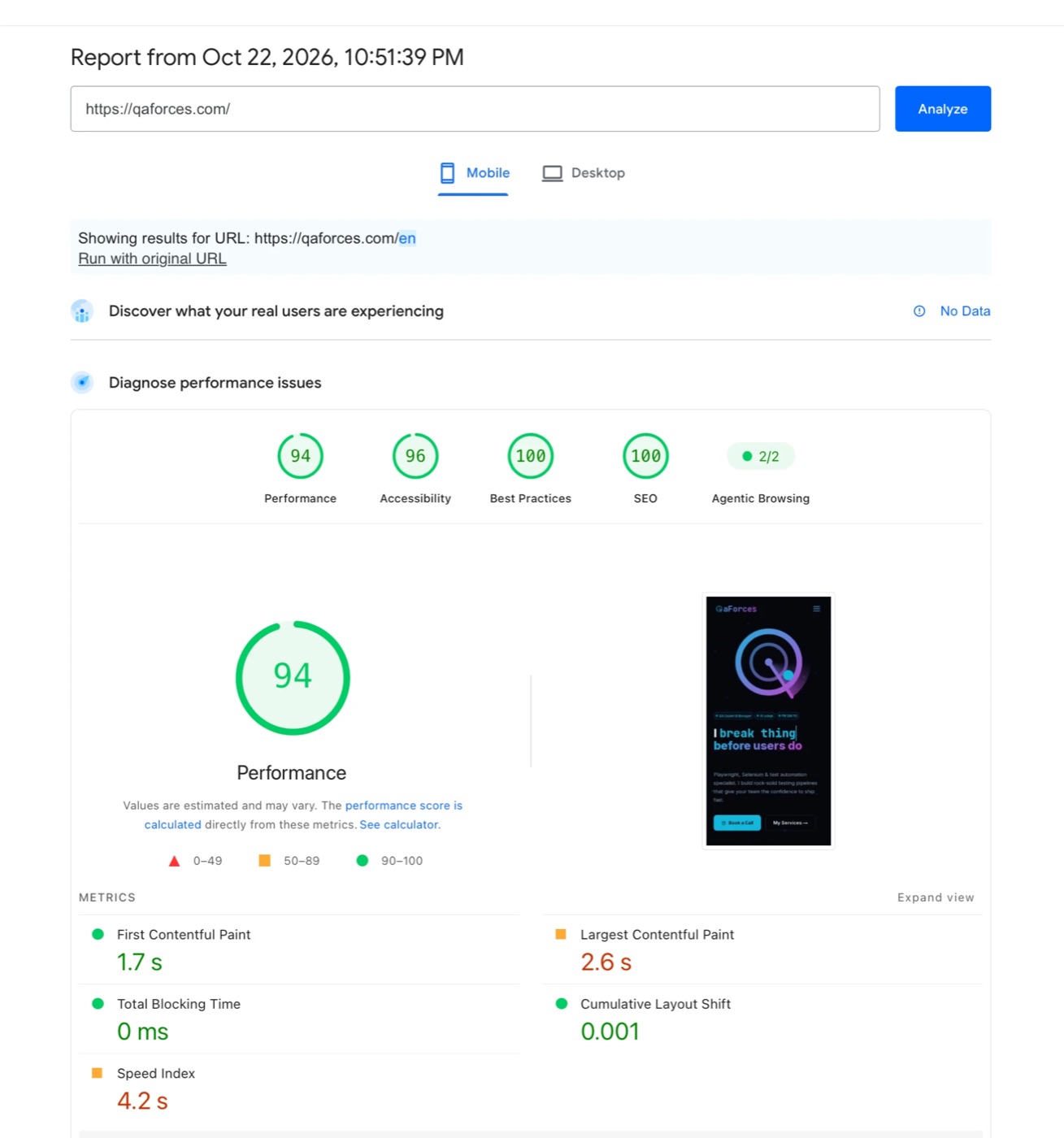
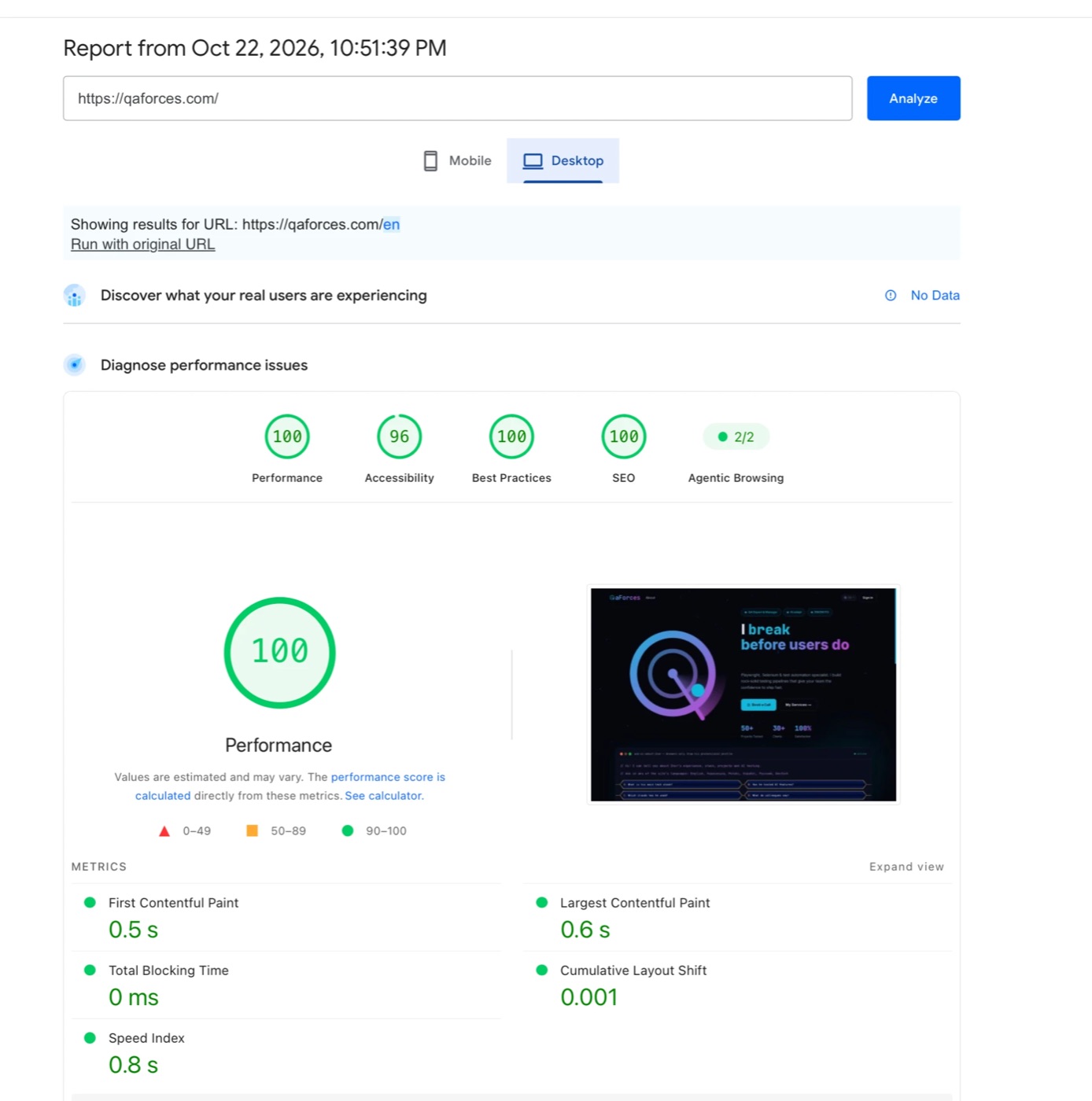
Results: Google PageSpeed Insights
The home page, tested on 22 October 2026:
- Mobile — Performance 94, Accessibility 96, Best Practices 100, SEO 100, Agentic Browsing 2/2;
- Desktop — Performance 100, Accessibility 96, Best Practices 100, SEO 100, Agentic Browsing 2/2: first content on screen in 0.5 s, the main content in 0.6 s, 0 ms of blocking, layout shift 0.001.
How did we get there, and why? The site lives on the free Cloudflare Workers plan, which gives each request only about 10 ms of CPU time — less than it takes to build a page on the fly. That was tested in practice: the first version drew the social media card at the moment of the request, and the site went down with error 1102. So the rule became part of the architecture: everything that can be computed in advance is computed in advance — on my own computer, at build time. Every page in all six languages is built into ready HTML, and Cloudflare serves it as a plain file without running a single line of code; the social media cards are drawn there too; the AI chat’s knowledge base is indexed there too; the fonts are downloaded at build time and served from our own domain, with no chain of requests to Google; the two visit counters load only once the page is already ready. The goal was simply to fit into the free limit and pay not a cent for hosting — the speed for visitors came as a side effect. These are the very «constraints as part of the design» from the list above: the agents wrote the code, but deciding where the line runs and why always stays with the engineer.